Family beyond blood ties
Lessons in ChemistryFamily beyond blood ties is a central idea in the novel, which repeatedly separates biological ancestry from the relationships people actually live. A blood test can establish that two people are strangers in genetic terms without undoing a father’s love; a family photograph can hold a dead man, an unborn child, a woman, and a dog; and a family tree can make room for a person whose connection to its central branch is not one of descent. The concept is not that biology is irrelevant to everyone, but that biology cannot by itself decide who belongs.
Biology and lived parenthood
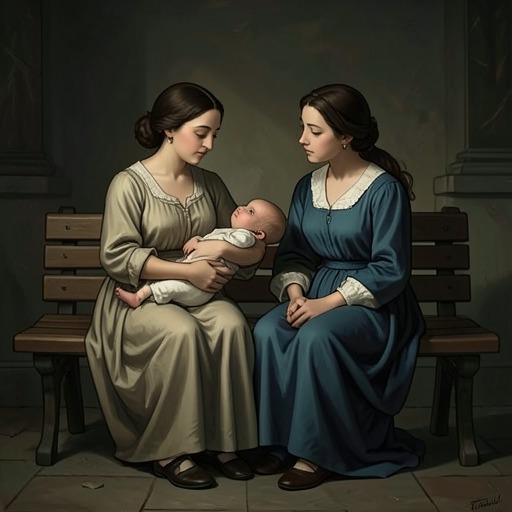
Walter Pine discovers that Amanda is not his biological daughter only after his ex-wife’s repeated insinuations lead him to take a paternity test. The results, which arrive five days after he provides a blood sample, confirm that he and Amanda are genetically unrelated. Yet the revelation does not produce the loss or betrayal he expects himself to feel. He already knows her as his daughter through the lasting bond of holding and raising her, and the test changes no part of that relationship. He loves her with all his heart and remains her devoted father.
Walter’s response gives the idea its most direct formulation: Biology was overrated. His conclusion is grounded not in a rejection of the test’s factual result, but in its inability to describe the fatherhood that matters to him. He had not planned to become a parent, yet parenthood became part of his life through his relationship with Amanda. His experience counters the assumption that intention, genetic resemblance, or biological proof must precede family. What he has practiced as a father outweighs what the test says about ancestry.
A family contained in a photograph
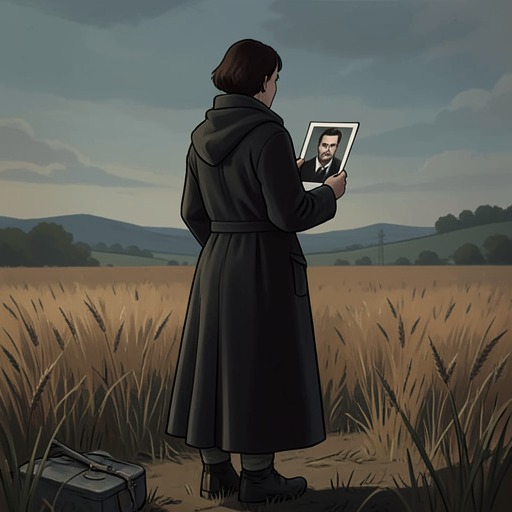
Madeline Zott’s account of a family photograph makes the novel’s broader definition more complicated and more vivid. She brings Reverend Wakely a clipping from Calvin Evans’s funeral, its image showing Elizabeth Zott and Six-Thirty watching the earth cover Calvin’s casket. Madeline identifies Elizabeth as her mother, herself as still inside her mother, and Calvin as in the box. The picture is a family portrait precisely because it preserves their connection at a moment of separation: Calvin is dead, Madeline has not yet been born, and the child can nonetheless locate every member of her family within the image.
Wakely initially asks how a funeral clipping can count as a family picture. His answer develops into a challenge to the logic of the family tree: people are animals, not plants, and therefore need not fit a model in which family is represented only as branches and descent. Madeline recognizes that this is what she had been trying to explain to Mrs. Mudford. The exchange links family belonging to shared love, memory, and connection, while also showing how an ordinary diagram can fail to represent the family a child knows herself to have.
Names, stigma, and the child’s perspective
The same distinction between a person’s identity and society’s labels appears when Elizabeth explains that Madeline was born out of wedlock. Madeline knows what the word means but cannot understand why it should matter. Reverend Wakely backs Elizabeth’s explanation with a broader criticism: the stigma of illegitimacy is a social myth, one among the distortions produced by culture, religion, and politics. He urges Madeline not to accept the label as a truth about herself or her family.
The scene gives the concept a social dimension. Biological parentage may be real, but the judgment attached to a child’s birth is imposed by convention; it does not establish the value or legitimacy of the relationships around her. Elizabeth notices that this argument, although attributed to her in the Life article, did not make it into the published account. The omission contrasts the family’s own effort to challenge a false social category with a public narrative that leaves out the challenge. Madeline’s plain question—why her birth circumstances should be a big deal—exposes the gap between a child’s lived sense of belonging and adult systems of classification.
Loss, consolation, and the limits of easy answers
When Miss Frask tells Madeline that Calvin and Elizabeth were happy together and that Calvin left Elizabeth a gift in Madeline, she offers the child an affectionate account of her parents’ relationship. Madeline is not wholly persuaded by this kind of reassurance. She reads it as an adult attempt to cover something darker, recalling Wakely’s assurance that a dead relative had not suffered and questioning whether anyone had asked the person who died. Her skepticism matters: family stories can comfort, but a child’s grief is not settled simply by framing her existence as a gift.
That tension keeps the concept from reducing to a sentimental claim that love makes every loss harmless. Madeline’s father died before she was born, and she must understand him through other people’s memories and the family traces left behind. Her place in the family is secure, but that security does not erase the absence she is trying to comprehend. The novel allows both truths to remain: kinship can be affirmed across death and separation, while grief and unanswered questions retain their force.
The family tree expands
Avery Parker’s eventual connection with Elizabeth and Madeline extends the idea from chosen or lived parenthood to a biological relationship interrupted by separation. Avery has spent most of her life not knowing what happened to her son, Calvin. She does not know what his adoptive family was like and remains uncertain whether the bishop’s account was wholly false or partly true. Her knowledge is fragmentary even after she learns that Calvin came to Hastings. The uncertainty makes her search more than a simple recovery of ancestry: the biological tie exists, but years of separation have left her without the shared history that ordinarily gives such a tie its everyday substance.
A letter from Madeline gives Avery a new route into that history. In her family-tree project, which appeared in Life, Madeline identifies Calvin as having been raised in a boys’ home in Sioux City and discovers that Wilson had funded it. She writes to thank him and says that the Parker Foundation belongs on her tree. The gesture begins as a child’s act of research and acknowledgment, but it reaches Avery through the foundation’s post-office box, where the letter is found beneath months of junk mail. Madeline’s project makes a distant institutional connection visible and helps bring Calvin’s birth mother into contact with the family he left behind.
Elizabeth then makes Madeline’s meaning explicit: it is Avery, not Wilson, whom Madeline has placed on the family tree. Avery understands herself through the image of the fairy godmother acorn. The metaphor gives her a place in the family without pretending that she shared Calvin’s upbringing or that she can recover the years she missed. Her relationship to him begins in biological motherhood, but her welcome by Elizabeth and her inclusion by Madeline create a present family connection that ancestry alone could not supply. Across Walter and Amanda, Madeline’s funeral portrait, and Avery’s arrival, the novel presents family as something both inherited and made: biology may open a line of connection, but love, care, memory, and deliberate recognition determine how that line becomes belonging.